Haeundae: Why Busan's Most Famous Beach Is So Much More Than Its Name
Every visitor to Korea has heard of Haeundae — but few know the full story behind the name, or why this stretch of shoreline continues to reinvent itself long after the summer crowds have gone home.
Introduction
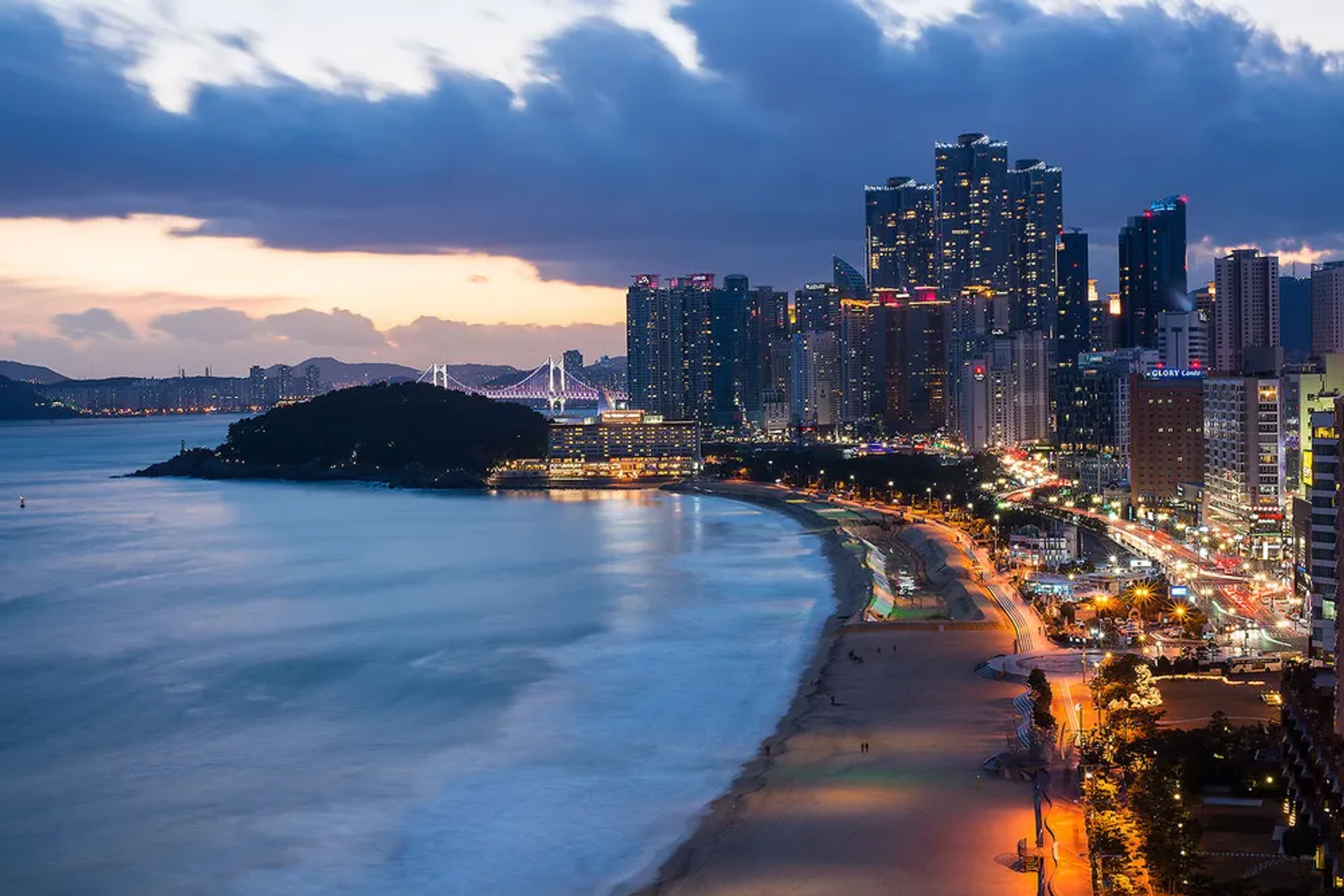
Haeundae is South Korea's most iconic beach. Stretching roughly 1.5 kilometres along the coast of Busan's Haeundae district, with a width of 30 to 50 metres, it draws hundreds of thousands of visitors on a single peak summer's day — making it the largest urban beach in the country. What makes the view truly striking, though, is what stands directly behind the sand: a wall of gleaming skyscrapers that rise above the shoreline, creating one of Korea's most recognisable and unlikely skylines, where beach umbrellas and tower blocks share the same frame.
The Story Behind the Name
The name *Haeundae* (해운대, 海雲臺) traces back, by the most widely told account, to Choi Chiwon — a celebrated scholar and poet of the Silla dynasty (57 BCE–935 CE). The story goes that Choi was so captivated by the beauty of this coastline that he built a pavilion here and named it after his own pen name, *Haeun* (海雲), meaning "sea cloud." The character *dae* (臺) means "terrace" or "elevated platform," and so *Haeundae* — "the terrace of the sea cloud" — was born.
It's an origin story that suits the place. Even during the Joseon dynasty (1392–1897), Haeundae was already celebrated as a scenic spot of note. In the modern era, it grew from a regional favourite into a destination with genuine national recognition — and in the 2000s, it transformed again. The construction of Marine City, a gleaming cluster of luxury high-rise residential and hotel towers on the beachfront, gave Haeundae its current split personality: part classic Korean seaside resort, part futuristic urban waterfront. The 2009 disaster blockbuster *Haeundae*, in which a mega-tsunami obliterates this very shoreline, cemented its status in the public imagination — and reportedly drew even more curious visitors rather than fewer.
The result is a place that no longer belongs only to summer. Haeundae has become a year-round landmark, a symbol of Busan itself.
On the Ground Today
Getting here is easy. Haeundae station on Busan Metro Line 2 deposits you almost directly onto the beach — and the broader area is well served by buses, making a car unnecessary and, during peak season, inadvisable (summer parking is a genuine headache).
The beachfront strip is dense with cafés, seafood restaurants, and the kind of late-night street food stalls that are best encountered after dark. But the appeal extends well beyond the sand itself. A short walk brings you to Dongbaek Island — a small, pine-forested peninsula jutting into the sea — and at its tip, the Nurimaru APEC House, a striking modernist building that hosted the 2005 APEC summit and now offers sweeping views back across the bay. Further along the coastal path is Dalmaji-gil, a winding hillside road beloved for its cherry blossoms in spring, and beyond that the small fishing village of Cheongsapo, which feels a world away from the bustle of the main beach.
Each autumn, the area gets a further injection of energy when the Busan International Film Festival (BIFF) comes to town. The main venue, Busan Cinema Center (known locally as Yeonghwa-ui Jeondang), is just inland from the beach, and during festival season the whole neighbourhood hums with a particular creative electricity.
For families travelling with young children, the practical infrastructure — beachside shower facilities, public toilets, accessibility — is genuinely good. For anyone who finds peak-season crowds overwhelming, the calculus is simple: visit in spring or autumn, when the light is softer, the promenades are quieter, and the evening skyline reflection on the water is worth the trip alone.
Ratings
Accessibility: ★★★★★ — Excellent public transport links via metro and bus; no car needed
Scenery: ★★★★★ — An unbeatable combination of open beach and urban skyline
Crowds: ★★☆☆☆ — Brutally packed in midsummer; manageable the rest of the year
Photo opportunities: ★★★★★ — The beach at night, Dongbaek Island viewpoint, and the Marine City skyline all deliver