Jeju Island
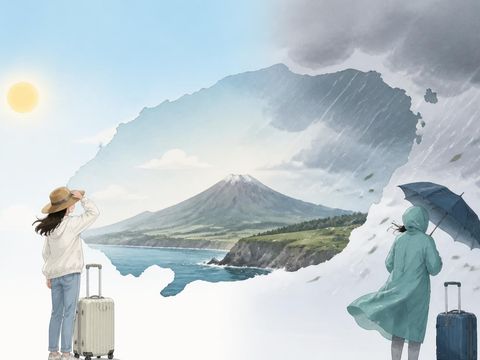
Jeju Weather Won't Ruin Your Trip — If You Plan Like This
Jeju's famously moody weather can unravel even the best-laid itinerary. Here's how to build a trip that bends with the forecast instead of breaking against it.
Odin Park
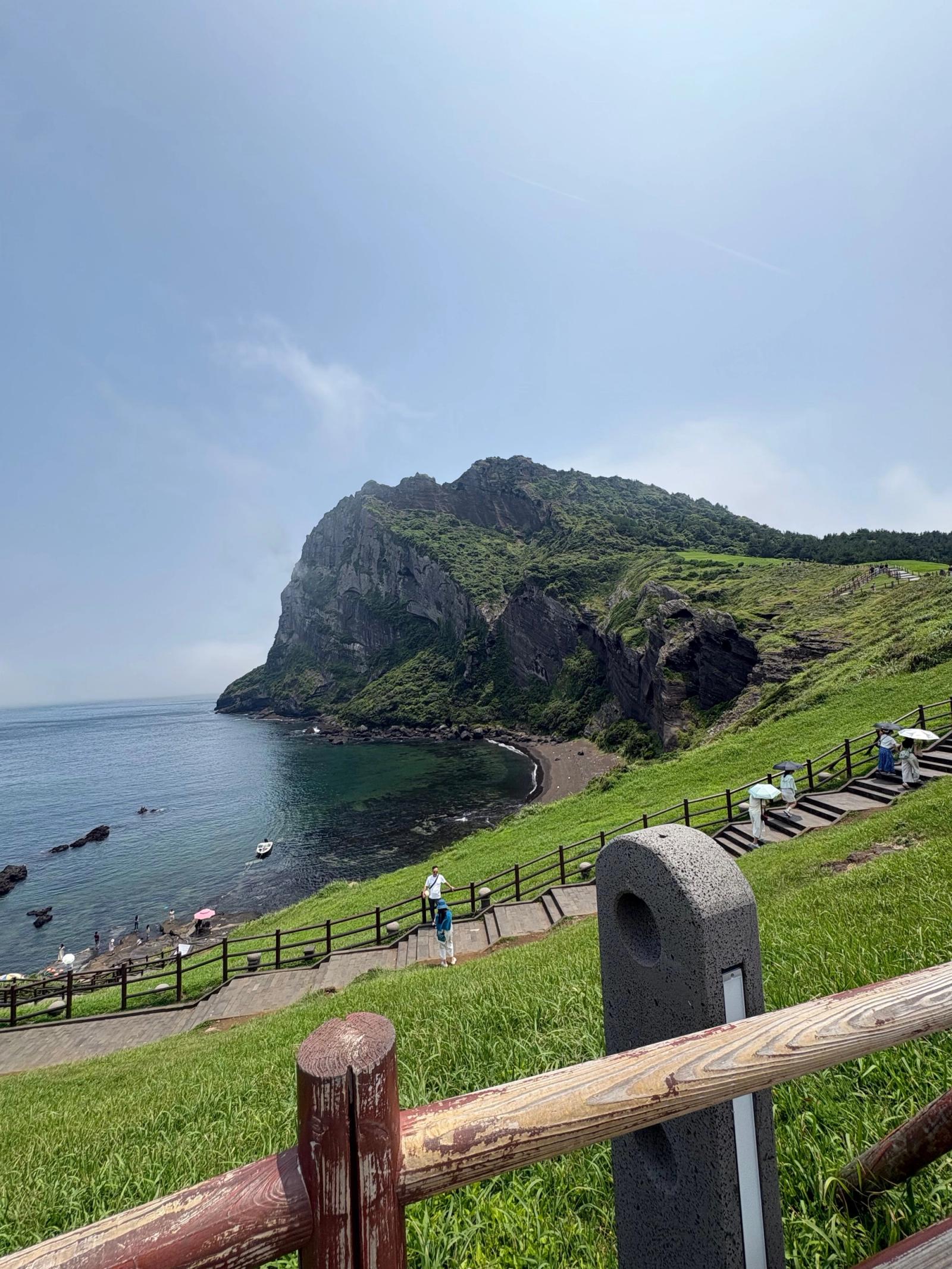
The crown-shaped crater of Seongsan Ilchulbong — a UNESCO World Heritage site born from an underwater eruption 5,000 years ago — is the image most people picture when they think of Jeju. Here's what to know before you climb it.
Introduction
Perched at the far eastern tip of Jeju Island, in the Seongsan area of Seogwipo City, Seongsan Ilchulbong is one of those places that earns every superlative thrown at it. Rising 182 metres above sea level, its summit cradles a massive crater some 600 metres across — and from the right angle, it looks uncannily like a great stone crown. That silhouette gave the peak its name: *seongsan* (城山) means "castle mountain" in Korean. The sunrise view from the top, *ilchul* (일출), gives the full name its poetry.
The honours have stacked up over the years. In 2007, UNESCO inscribed it as a World Natural Heritage Site; a Global Geopark designation followed. Today, Seongsan Ilchulbong holds all three of Jeju's major international nature designations — a distinction shared by very few places on the island. It's almost certainly the first stop on any first-time visitor's itinerary, and the image that shows up most reliably on Jeju postcards and tourism reels.
The Story Behind It
About 5,000 years ago, a volcanic eruption beneath a shallow sea created what we see today. When magma forces its way up through water, the result is explosive — far more so than a typical land eruption — and the interaction sends vast clouds of volcanic ash billowing upward. As that ash settled and hardened layer by layer, it formed the distinctive landform geologists call a *tuff cone*, or *응회구* in Korean. Seongsan Ilchulbong is considered a textbook example of this geological process, and it's regularly cited in academic literature on hydrovolcanism.
Originally, the cone stood as a separate island. Over centuries, accumulating sand and gravel gradually built up a natural causeway connecting it to the Jeju mainland — a sandy isthmus that, as a happy side effect, created Gwangchigi Beach along its western flank. At low tide, when the wide tidal flats are fully exposed, the beach offers one of the most photogenic angles on the entire crater: all that dark volcanic rock and green rim reflected in still, shallow water.
The name says it all, really: this is sunrise country. The view from the summit at dawn has been celebrated for centuries — it's listed among the *Yeongju Sipgyeong*, the ten legendary scenic views of Jeju, a classical canon that goes back to the Joseon era. On New Year's morning, the path to the top is packed with people waiting to see the first sunrise of the year. But the peak performs beautifully at any hour: in daylight, it's the emerald sweep of the crater rim and the open sea views toward Udo Island (a small island just offshore, easily reached by ferry from nearby Seongsan Harbour) that draw the photographers. The vegetation inside the crater shifts with the seasons too — silvergrass in autumn, yellow canola flowers in spring — giving regulars a reason to keep coming back.
Planning Your Visit
The trail to the summit is a series of stairs — round trip takes roughly one to one and a half hours at a comfortable pace. It's manageable for most ages and fitness levels, though parents with very young children should know there's no way to push a stroller beyond the entrance. Many families check their pram at the gate and carry their little ones up in a baby carrier or hip seat; if you're travelling with an infant, it's worth packing one.
Near the entrance, a performance area hosts *haenyeo* diving demonstrations — the *haenyeo* are Jeju's celebrated female free-divers, women who have harvested seafood from these waters for generations, and their tradition was itself inscribed on UNESCO's Intangible Cultural Heritage list in 2016. Pairing the crater climb with a haenyeo show makes for a satisfying half-day. Performance times vary by season and weather, so it's worth checking ahead.
The car park fills up fast on busy days; arriving early will spare you a headache. The path from the ticket gate to the summit has little shade, so in summer, bring plenty of water and a hat — the sun here means business.
The surrounding area rewards a longer stay. Seopjikoji (a dramatic coastal headland a short drive away), Gwangchigi Beach, and the Seongsan ferry terminal for Udo Island are all within easy walking or driving distance. Most visitors fold all of these into a half-day or full-day loop through the Seongsan area — and it's a loop that feels exactly the right size.
At a Glance
Accessibility: ★★★★☆ — Both parking and public transport are easy enough; the stairway sections require a bit of effort but nothing extreme. Scenery: ★★★★★ — Sunrise, crater, open sea: it delivers on all three. One of Jeju's definitive views. Crowds: ★★☆☆☆ — Can get very busy during peak season and around New Year's sunrise. Come early. Photo opportunities: ★★★★☆ — The summit viewpoint is the obvious choice, but don't overlook the wide-angle shots from Gwangchigi Beach, with the crater as your backdrop.
Jeju's famously moody weather can unravel even the best-laid itinerary. Here's how to build a trip that bends with the forecast instead of breaking against it.
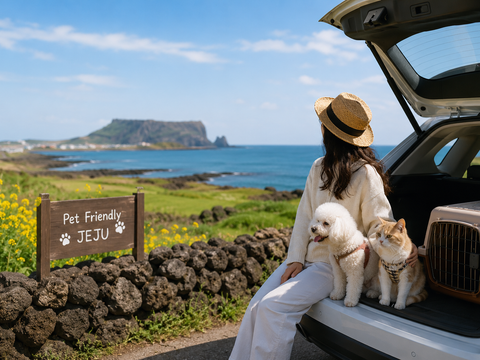
Jeju Island is fast becoming one of Korea's most pet-friendly destinations — but travelling there with a dog or cat takes more planning than you might expect. Here's how to get it right.
Every rock, every crater hill, every handful of rice on Jeju tells a story — if you know how to listen. Here's how to walk this island the way it was always meant to be walked: slowly, and with wonder.